At Nurabare, we believe in “Bare Beauty” the philosophy that your skin should look its best without a mask of makeup. To achieve that, you need to understand the science behind the bottle. This guide will walk you through everything from tyrosinase inhibition to the latest in liposomal delivery systems.
1. The Science of the Glow: How Vitamin C Transforms Skin
Vitamin C is far more than just a “brightener.” It is a multi-functional powerhouse that targets the skin at a cellular level.
Tyrosinase Inhibition: This is the biological “secret sauce.” Vitamin C brightens skin by inhibiting tyrosinase, the rate-limiting enzyme responsible for melanin production. By slowing this process, it prevents the formation of dark spots before they even reach the surface.
Collagen Synthesis & Fibroblasts: Your skin’s firmness depends on collagen. Vitamin C acts as a critical cofactor for the enzymes that stabilize collagen fibers. It essentially “signals” your fibroblasts (the cells that produce connective tissue) to ramp up production, leading to firmer, younger-looking skin.
Antioxidant Protection against UV Damage: While it’s not a replacement for sunscreen, Vitamin C neutralizes free radicals caused by the sun. This defense mechanism prevents photoaging the premature wrinkles and leathery texture caused by chronic UV exposure.
2. Choosing Your Molecule: L-Ascorbic Acid vs. Derivatives
Not all Vitamin C is created equal. The molecule you choose determines how your skin reacts.
L-Ascorbic Acid (L-AA): The “Gold Standard” of pure Vitamin C. It is highly effective but notoriously unstable and can be irritating for beginners.
Stable Derivatives: If you have sensitive skin, look for Sodium Ascorbyl Phosphate (great for acne) or THD Ascorbate (an oil-soluble version that penetrates deeper).
Water-soluble vs. Oil-soluble: Standard L-AA is water-soluble, meaning it struggles to pass through the skin’s natural oils. Oil-soluble versions like THD Ascorbate have higher bioavailability, meaning more of the “good stuff” actually reaches your cells.
Nurabare Tip: For beginners, we recommend a 5% to 10% concentration. Jumping straight to 20% can disrupt your skin barrier, causing redness rather than radiance.
3. The Nurabare Standard: Stability & Technology
The biggest enemy of Vitamin C is oxidation. If your serum has turned a dark orange or brown, it has oxidized and is no longer effective.
To combat this, modern skincare utilizes Liposomal Vitamin C technology. This involves encapsulating the Vitamin C in tiny lipid spheres (liposomes) that protect the molecule from air and light, ensuring it stays potent until the very last drop.
4. How to Layer Like a Pro: Routine & Compatibility
A common myth is that you can’t mix “actives.” Let’s set the record straight for 2026.
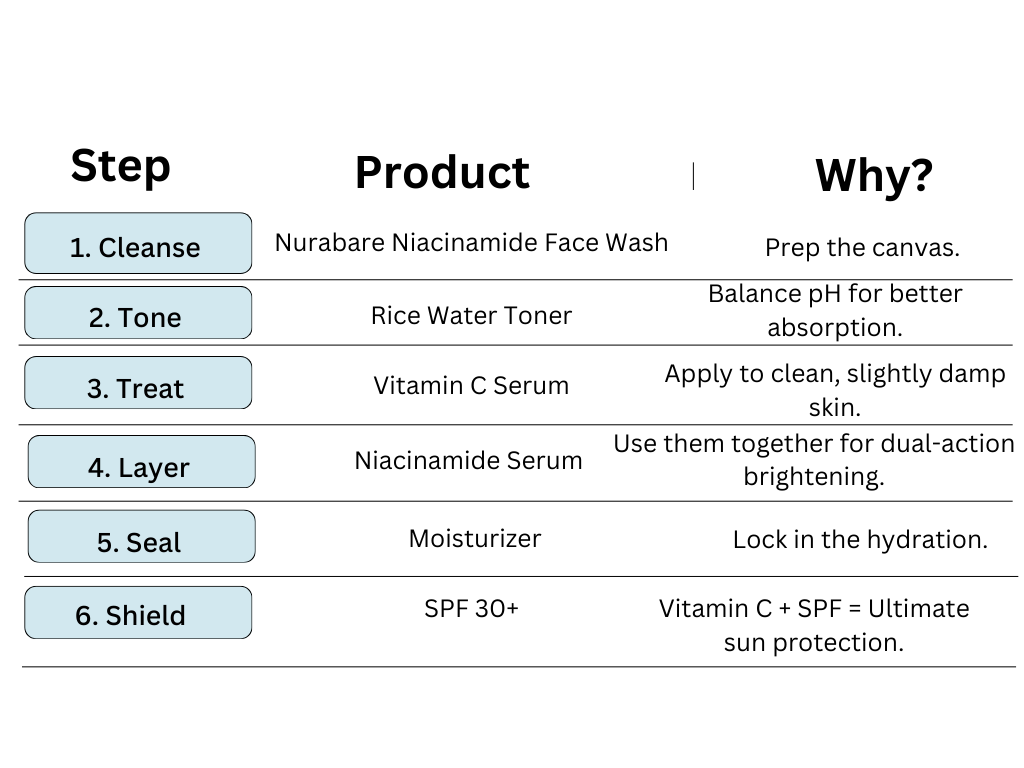
Timing Matters: Apply your Vitamin C in the morning to take advantage of its antioxidant properties during the day. If you use Retinol, save that for your night routine to avoid “conflict” and irritation.
5. Solving Specific Concerns
For Acne-Prone Skin: Use non-comedogenic Vitamin C to fade post-inflammatory hyperpigmentation (acne scars) without clogging pores.
For Under-Eye Circles: Vitamin C targets vascular and pigmentary dark circles by strengthening the thin skin under the eyes.
For Dull, Tired Skin: A quick application provides an immediate “radiance-boost” by smoothing the skin’s surface texture.
Frequently Asked Questions (FAQ)
Q: What is the ideal pH level for Vitamin C absorption?
A: Pure L-Ascorbic Acid requires an acidic pH of around 3.5 to penetrate the skin effectively. Nurabare’s formulations are precision-balanced to ensure maximum efficacy without the sting.
Q: Why should I look for Ferulic Acid and Vitamin E?
A: This is the “Power Trio.” Ferulic Acid doubles the photoprotective power of Vitamin C, while Vitamin E replenishes skin lipids. Together, they create a synergistic shield against environmental stress.
Q: How long should I wait after applying my serum?
A: Give it about 60 to 90 seconds to fully absorb before moving to your next step. This prevents “pilling” when you apply moisturizer.
Q: Does Vitamin C help with redness?
A: While it’s primarily for brightening, stable derivatives like Sodium Ascorbyl Phosphate have anti-inflammatory properties that can help soothe sensitive skin redness.